Podcast Interlude: Ryan Holiday's Rules for Reading
If there must be rules...

It sometimes strikes me as odd that I read (and listen) as much about reading as I do reading other stuff. Ryan Holiday is one of my favorites, and if you’re not subscribed to his monthly reading emails, I suggest you’re missing out. Holiday also owns a bookstore in Austin, Texas that is high on my R&D list. A friend recently asked for my thoughts on his January video in which he claims he can teach you how to read like a pro in sixteen minutes. I obliged.
A note of caution before I dive in. Those who know me well know that I chafe as soon as I hear the word “rules.” This of course is more with regard to externally imposed constraints, but it still makes me uneasy. I’ve also followed recent discussions about the merits of “reading goals,” such as the virtually ubiquitous Goodreads reading challenges. Full disclosure, I adore Goodreads for tracking my reading, especially the “want to read,” and for finding new suggestions from friends. My son’s fourth grade English teacher, now retired, is my #1 most reliable source for new fiction recommendations. I’m looking at you, Mrs. Germain! I’ve also never participated in one of their new year reading challenges…
But on to Holiday. He opens by arguing that there are no short cuts or hacks for good reading. Instead, he offers strategies for individuals to be able to read more and to get more out of the books they read. So far, so good.
Within his list, there’s a lot of gems, and a lot of redundancy, and a fair amount of disdain for reading for pleasure. I’ll comment on each rule:
Quality over quantity. Holiday wants you to read only “great” books, the “right” books, time and life being short. His emphasis is on helping the reader better process and retain what she’s reading, ultimately being able to apply it. Sounds great. That said, there are many books I read just “for fun.” There are many I won’t remember years after reading them, and that’s OK. If you think about what I could be doing in lieu of reading horror novels, for example, I still feel I’ve made the rights choice. Read what you want! Get serious about some if you want. Or not. It’s up to you.
Always carry a book. I mean, what is there to say? Of course you should always have a book on you.
Read with a pen or you’re not really reading. Holiday and I are advocates for marginalia, highlighting, and taking notes. (Show me your most-loved book in the comments!) He asks us to think about reading as “the great conversation,” an apt analogy. I would say I view reading as exchange- with the author, with others who have read the same text, and often in conversation with others about the text. And as for your favorite genre for pleasure reading, see above.
Books are not precious. Holiday urges that books are meant to be read and that’s how you show your respect to the author. Write in them, note your favorite passages, add questions you’d love to ask the author and/or discuss with friends. It’s also a way of marking your history. Someday, someone might be interested in what you thought. Agreed, again with the caveat of your “fun” reads. Here I must also make an exception for rare books. If you write in my 6th edition Theory of Moral Sentiments, look out. And if you spill food on it, look out…
Read while you eat. This one is just gross. Yes, I agree reading in a bar is cool and I will 100% lurk and try to find out what you’re reading. If it sounds interesting, I’m going to try to talk to you, too. There are definitely accidental coffee, tea, and wine stains in many of my books. But slopping food on books is not an inherent sign of respect, nor is showing off your stains the same as showing off your marginalia. I have no problem with people reading while they eat but use your manners for heaven’s sake.
Stop watching the news. This is advice I’ve been following for years. Holiday argues that reading books as the best way to understand what’s happening in the world. The news is designed for curiositas, not studiosis. Do yourself a favor and consume less of it.
Re-read books. I love how Holiday says that when you re-read a book, the book is the same, but you are different. Re-reading offers you what you need at this moment. It can also good way to get out of a reding slump; it’s a sure thing. I seldom re-read. If you’re a re-reader, tell me what you re-read and why. How was it different the second (or twenty-second) time around? How do you know what you want to re-read?
Don’t be a snob. Yes! If something is popular- whether a “classic” or a new bestseller. Find out what the hype is all about. Sometimes you’ll disagree, as I did with Where the Crawdads Sing. Other times, you’ll be moved more than you know, as I was with A Gentleman in Moscow. It’s also interesting to see the new seasons of an old book. Look at the love The Count of Monte Cristo and Wuthering Heights are getting online today- and only one with a new movie coming out. Much though I like this rule, though, it seems contrary to Holiday’s rule 1. What do you think?
Keep a commonplace book. I aspire to keep a record of taking extracts from my reading. In practice, if it’s a book I’m reading for “work,” generally one I plan to write about, I will have extensive marginalia and follow-up notes. I don’t do this with books I am reading purely for pleasure. Should I? If you’re a writer, you might be intrigued by Holiday’s note-card method. I include his explanatory video on that below.
Quit bad books. Another one I agree with and really need to work on! You’d think I’d take my own classroom advice and ignore sunk costs. Holiday asks why we’re so willing to stop watching a bad TV show, but feel we have to finish a bad book? His proposed formula of 100 pages minus your age seems…er, short. What say you? Give me advice on this if you’re good at this quitting!
Good books aren’t hard. I’m taking a hard pass on this one. It’s certainly the case that good books aren’t necessarily hard. But you know what is hard? Learning! And if you want to learn from a book- whether in terms of knowledge acquisition or emotional intelligence- it takes effort. But it’s effort that’s worth it! Perhaps Holiday isn’t equating “hard” with “effort.: Regardless, I’ll stick by what I’ve been saying in my ongoing reading series, and particularly in my last post. Real learning takes more than just curiosity; it also requires sustained cognitive effort.
As people you admire to tell you about a book that changed their life. 100% yes. I’d add not just people you meet in real life. Find out what people from the past you admire have read. Some of my own favorite lists are a catalog of all the books in Adam Smith’s library, along with Liberty Fund founder Pierre Goodrich’s list of recommended reading. (I’ve got a long way to go…)
Look for wisdom but not facts. Look for both; you can’t build wisdom on a fact-less foundation. This rule is totally contrary to Ian Leslie ’s advice, with which I agree. Wisdfom is built on a foundation of facts. seeking facts don’t necessarily mean you’re preparing for something concrete, like a test or for trivia night. But you are preparing your scaffolding for future learning. You don’t need to know what you’re going to do with the information.
Find your next book in your current book. In my mind, this is largely the same as rule #12. Holiday recommends reading the bibliography, notes, acknowledgements, etc. in each book you read to find your next one. I do love his analogy of reading like a monkey swinging from vine to vine. But this also contradicts his previous rule. Finding a book this way is synonymous with discovering a knowledge gap you wish to exploit.
Read everything by authors you love. Again, I think this is effectively the same advice as in earlier rules. Holiday does make the excellent point here that doing so enables you to follow the evolution of the author’s thinking.
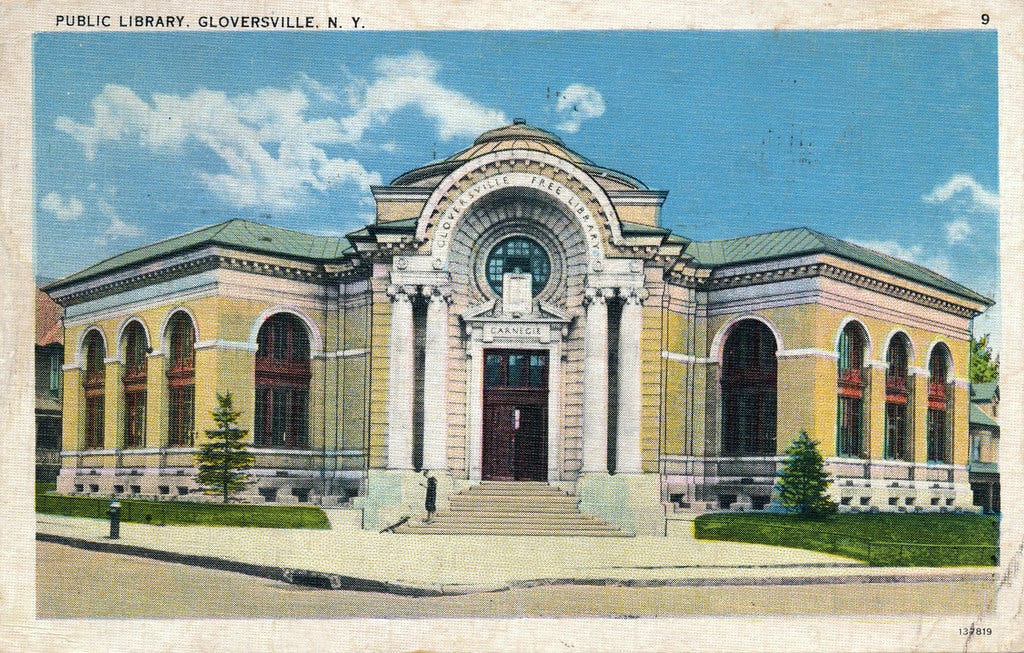
Buy books immediately. I am an aspiring bookseller. What else can I say? But I’ll also make a plug for using your local library. (Below is a picture of the stunning Gloversville Public Library, where I spent many happy hours as a kid.)
Speed reading is a scam. I suspect this is true but admit I’ve never tried it. What fun would that be??? Holiday argues that increasing your pre-existing knowledge the only way to speed up your reading. (True, though contradicts his rule 13…)
Build an anti-library. This one is fun. Your TBR pile should be ambitious. Holiday insists you should look for books that humble you and illustrate what you don’t know yet. Yep.
Read like a spy in the enemy’s camp. Again, Holiday and I both believe that reading is a conversation. It can also be an argument. Read authors with whom you disagree. It’s true you can’t argue your own case if you don’t understand the enemy’s. Take a lesson from high school debaters.
Go to bookstores. Enough said, and again plugging the library. This is the best way to find the books you didn’t know you were looking for. Give chance a chance, as Holiday says. Browsing is a better discovery engine than any algorithm.
Don’t skip prefaces. I have mixed feelings here. On the one hand, I fear this can decrease serendipitous enjoyment. But Holiday has a point if you’re reading with a specific goal in mind, He motes he reads everything he can about the book he’s reading- reviews, podcasts, whatever. This one strikes me purely as personal preference,
Pay it forward. If you love a book, share it. Literally or by recommending it. If you’ve made it this far, I’ll just go ahead and assume you agree.
In the video below, Holiday explains his three-step method to read like a pro, posted especially for those interested in learning about his note card system.
I sure do love this topic and I'm so glad I suggested you to tackle this list. I have thoughts about your thoughts :)
#3 I never, ever use pen. All of my underlining and marginalia is done in pen. And I adore tiny post-it notes.
#5 Totally.
#7 I'm now a re-reader. Sometimes it has been because of a book club selection and I want to be refreshed, other times, it's just for me. I've read some books 3 and 4 times. Some of the authors are Marilyn Robinson, Joan Didion, Jane Austin, Barbara Kingslover. I just realized they are all female authors.
#8 I'll read a hyped book and see a hyped movie. I like to be part of the buzz.
#9 I always wish I would start this notecard system, and I don't.
#11 I love hard, it makes me slow down.
#12 Such a long way to go
#14 I'm halfway through Easterly's Violent Saviors and have collected an extensive reading list!
#15 Absolutely
#16 I must go there.
#17 I can speed read through lesson prep on a historical topic, or boring work stuff to do a project, but I rarely use that skill on books that I choose.
#20 Strand!
#22 Best gifts on earth.
Thanks for doing this!
Amy! I think we are the same reader. Thank you for this!