The Conversation Collector
Wrapping up Zena Hitz and looking ahead.

In my last post, I considered Zena Hitz’s “how-to” advice for living a rewarding intellectual life. In her final chapters, Hitz turns from exemplars to obstacles, focusing on the distractions that threaten intellectual seriousness- wealth and status, ambition, and politics. She offers what she calls “compelling stories of corruption and redemption”—accounts of how intellectual lives can be distorted, lost, and sometimes recovered.
As with the stories offered in her previous chapter, these are not easily summarized without flattening them. I see little value in recounting them here. They deserve to be read in full and interpreted personally. (I will note that Hitz’s discussion of Elena Ferrante’s Neapolitan novels has convinced me to re-read My Brilliant Friend, as I clearly missed a lot. A re-read is clearly in order.)
How does Hitz advise we protect our inner lives from such distractions? Through t” “informed self-examination” and “escaping through the creation of art.” (127)
To explain why these practices matter, Hitz turns to Augustine and introduces a distinction that becomes central to her argument: curiositas and studiosis.
As I mentioned in a previous post, curiosity is the first pillar of my project. What deserves cultivation, she argues, is not curiositas but studiosiss. The alliteration may be less charming, but the distinction matters.
Curiositas is the love of spectacle- the novel, the thrilling, the shocking, and often the negativity. It is appetitive and immediate, pursued for its own sake rather than for growth. Importantly, Hitz does not condemn curiositas. Its spark is often the beginning of learning, and it represents freedom of thought in action. It becomes problematic only when it remains an end in itself—when it never deepens into a search for something more.
Most of us engage in curiositas constantly. Think of hobbies. For me, cooking, music, travel, wine tasting, and yes, much of my reading fall into this category. I enjoy them in the moment, for the sake of enjoyment. And often, that is enough.
But sometimes, one such activity leads to something more akin to studiosis. A small example: My son and I love the Gordon Lightfoot song “The Wreck of the Edmund Fitzgerald.” That provided a spark of curiositas when I learned about John Bacon’s new book, The Gales of November. My initial desire to read Bacon’s book was the promise of learning about the lives of the 29 sailors who perished; it did not disappoint! But I didn’t know I wanted to learn so much about Great Lakes shipping and weather, the economic history of the Lakes, and yes, even more about the song. (So much I want to share, but no spoilers!)
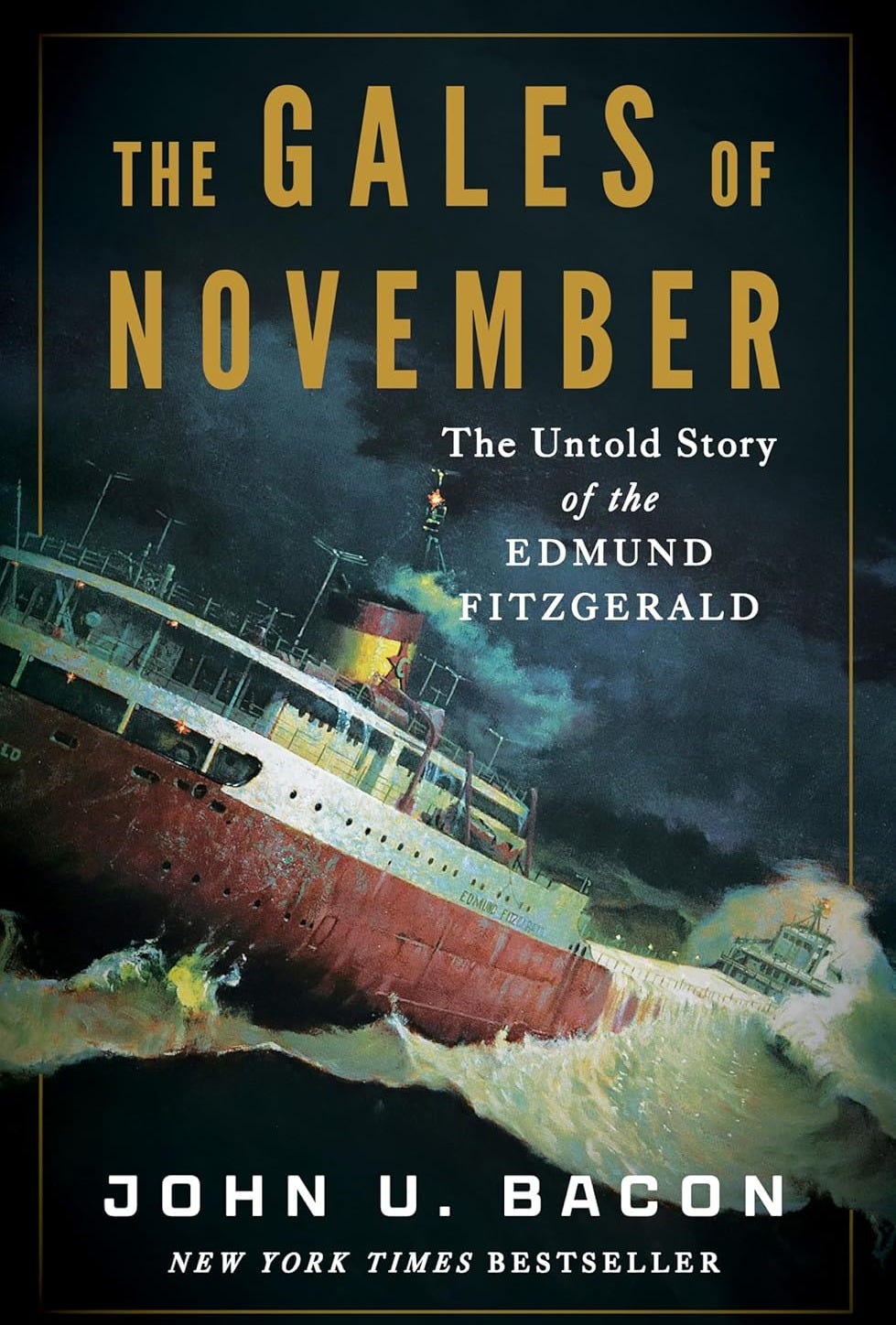
Will my newfound knowledge lead to studiosis? It may be too soon to tell. Hitz writes that the individual experiences studiositas as one who “restlessly pushes for the better, the truer, the more profound.” (144) I may be on that path. At the very least, my reading deepened and my understanding widened.
What matters for my purposes are two points: the symbiotic relationship between curiositas and studiositas, and the restlessness inherent in both.
As Hitz puts it:
Work for the sake of work is pointless; it ought to culminate in something further. But it does not feel pointless, because we thrill in our own action and experience. (141)
What, then, distinguishes the love of spectacle (curiositas) and the love of learning (studiosis)?
Hitz answers carefully:
…it may be difficult to distinguish the love of learning from the love of spectacle in particular cases, but that is what one would expect, given that each can be integrated into the drive of the other. (139)
The distinction is not always visible from the outside. Both curiositas and studiosis are capable of lighting a spark in the other. What starts as a curious spark may deepen into a direction, as interest in a new pursuit might be sparked as one pursues a given direction. This “free play of imagination” is exercised in each.
This brings us to restlessness. “To understand the virtue of seriousness,” Hitz writes, “we must understand its fundamental restlessness.” (145)
Curiositas is mediated by others; it requires an audience. Studiosis, on the other hand, is at heart solitary. But as discussed in my previous post, solitary does not mean isolated. The intellectual life requires companionship even when it is pursued alone.
Restlessness cannot be cured in isolation. It needs space—physical, intellectual, and social. This is the thread that ties my three pillars together: curiosity, conversation, and community. I want to create a space—virtual for now, concrete soon—where the restless can step away from “the world” and engage in conversation with others who feel the same pull toward depth.
As Hitz writes:
Whereas the lover of spectacle skims over the surface of things and is satisfied with mere images and feelings, the serious person looks for depth, reaches for more, longs for reality. (144)
And again:
Intellectual life involves a direction…it draws us on to something more, and then something more, until (and if) we reach a point where there is no “more.” (148)
In her final chapter, Hitz poses the question I didn’t know was the one I wanted: “How can the intellectual life help us to serve others?” (175)
Her answer, in part:
It is the virtue of seriousness that permits our thinking and learning to shape our moral lives and our lives with others. (175)
This book has been invaluable to me as I think about how to orient this next phase of my life. I want to continue to be serious—to allow learning to shape not only what I know, but how I live with others.
Hitz reminds us that:
…anyone furnished with the basic necessities of life can aspire to the splendor of humanity, even if his or her individual splendor is not widely known or recognized.
This resonated with me. I am not, and likely will never be, “famous” in any conventional sense. But I am known for something else: for collecting and connecting people. A dear friend recently gave me a new name for this habit. While many people collect people, he said, I collect conversation. I “make us read and talk.” Thus: the conversation collector.

It is no surprise, then, that Hitz’s discussion of “Freedom and Aspiration” particularly caught my attention. The intellectual life, she argues, cannot be sustained without freedom and leisure. One must guard against distraction, yes—but also claim the space, literal and figurative, to read and think. The intellectual life is a journey without a preordained end. Direction, not destination, is the only necessary map.
As Hitz beautifully puts it:
…the intellect must be left to lead us where it leads us, regardless of what we thought our goals to be when we started. (189)
Will the spark of curiosity that led me to Bacon’s book take me further than it already has? Who knows. This is why I want to hone my skills as conversation collector: to spark curiosity about people, stories, and ideas that people didn’t yet know they were interested in, and to help them find the fellow travelers who share the same spark.
So with gratitude for the trove of inspiration from Zena Hitz, welcome to GoodRiches. Come for the curiositas; stay for the studiosis. Let’s learn together.
Thanks for your report/review conversation starter with Hitz. (Also looking forward to NDD Sunstein and beyond. 🤓)
Direction not destination. ❤️